

Record-breaking Start and Lifelong Dedication
The festival kicked off on May 3rd with a big surprise right from the start. Howard Andrew pulled off something unexpected by winning the first two events of the series consecutively. In the initial $1,000 NLH event, he overcame a then-record field of 56 players. Five players took home winnings, including David Sklansky, a future renowned poker author, who finished third.
The very next day, Andrew triumphed again, this time in the $2,500 NLH, defeating Dewey Tomko heads-up. Interestingly, Dewey Tomko, a former kindergarten teacher, later admitted that poker funded his education and earned him more than teaching, making him a lifelong professional with winnings over $5 million.
Although Howard Andrew never added another bracelet to his collection, he made history again in possibly an even more remarkable way. From his debut in 1974, he played in the WSOP Main Event every year until 2018, totaling an unbelievable 45 consecutive participations.
Rewriting History
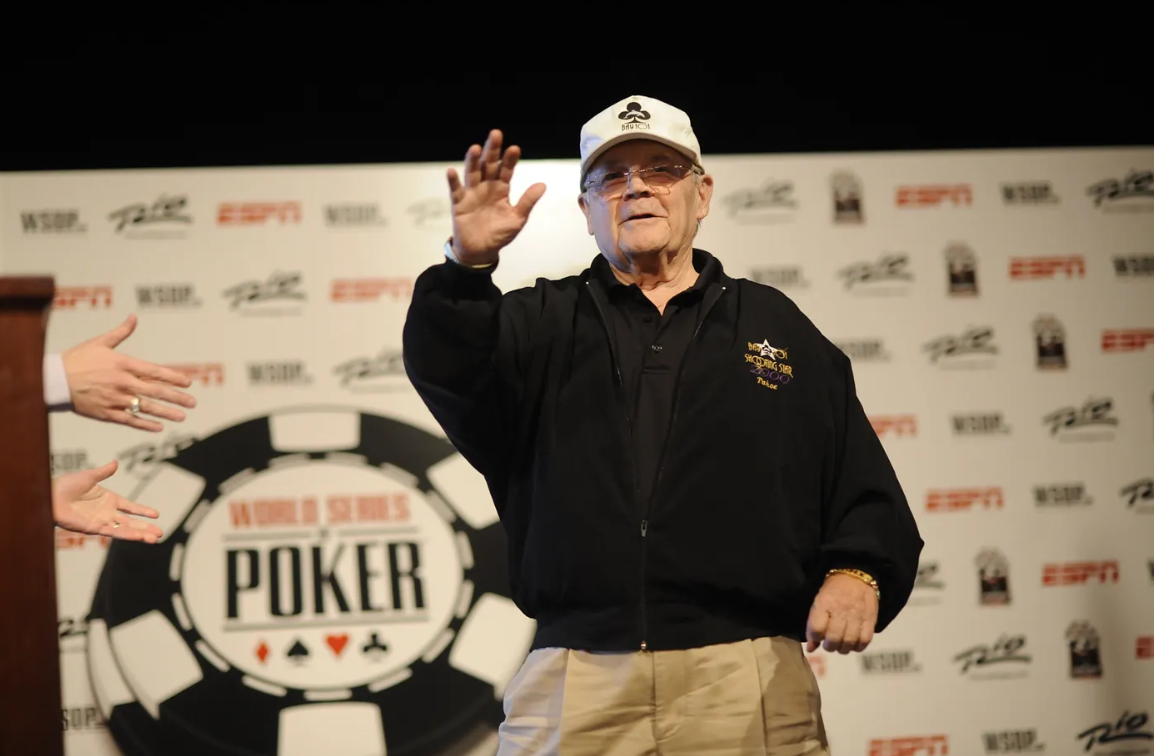
It was a year of new champions, with five players claiming their first WSOP titles. While new names emerged, only former champion Johnny Moss reaffirmed his position. The "Grand Old Man of Poker" won the $500 Seven-Card Stud event, securing his sixth bracelet. At the time, he was the uncontested WSOP title leader. Considering that he had just celebrated his 69th birthday, his achievements were even more astounding.
The $5,000 Seven-Card Stud event also marked a historic milestone. Walter Smiley became the first African American to win a WSOP gold bracelet. Eric Drache, the event's runner-up, was the tournament director and visionary who introduced satellite tournaments, the ante structure, and modern tournament rules.
|
Tournament |
Entries |
Winner |
Prize |
|
Event #1: $1,000 No-Limit Hold'em |
56 |
Howard Andrew |
$28,000 |
|
Event #1: $2,500 No-Limit Hold'em |
25 |
Howard Andrew |
$24,000 |
|
Event #1: $5,000 Deuce to Seven Draw |
26 |
Doyle Brunson |
$90,250 |
|
Event #1: $1,000 Ace to Five Draw |
80 |
Perry Green |
$68,300 |
|
Event #1: $1,000 Seven-Card Stud Split |
17 |
Doc Green |
$12,750 |
|
Event #1: $500 Seven-Card Stud |
52 |
Johnny Moss |
$13,000 |
|
Event #1: $5,000 Seven-Card Stud |
11 |
Walter Smiley |
$35,000 |
|
Event #1: $10,000 No Limit Hold'em Main Event |
22 |
Doyle Brunson |
$220,000 |
The Rise of a New King, "Texas Dolly"
The Main Event, with a $10,000 buy-in, attracted 22 participants, once again setting a new record, albeit by a single player. Along with the increase in participants, the prizepool reached a record $220,000 for the winner. Unlike the side events, the Main Event continued to use the winner-takes-all format.
Doyle Brunson, who had already secured his first bracelet during the series in the $5,000 Deuce to Seven Draw, was among the favorites. Brunson was the last of the legendary trio of Texas road gamblers lacking a world championship. Amarillo Slim won in 1972, and Sailor Roberts in 1975.
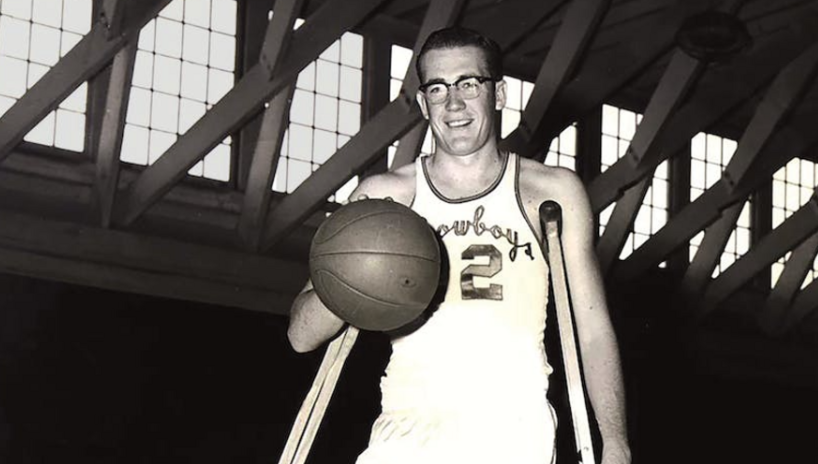
Doyle Brunson had a fascinating backstory. Before becoming the "Godfather of Poker," he was a talented athlete destined for the Minneapolis Lakers in the NBA. However, a severe leg injury ended his sports career, leading him to poker tables where he became a legend.
The Legendary Hand "10-2"
After three unsuccessful years, Brunson returned to the final table of the Main Event, facing legends like Crandell Addington and Bob Hooks. Notable too was Tommy Hufnagle, a Vietnam vet known as "Fast Eddie," whom Brunson greatly respected for his work ethic and talent. Yet, it was Doyle who knocked him out in third place when Hufnagle's pair of eights lost to Brunson's jacks.
In the heads-up for the title, Doyle faced Jesse Alto, a Texas car dealer. Alto, a skilled player, was in his third consecutive Main Event final. However, he was also known for struggling to control his emotions when things went awry. Knowing this weakness, Brunson patiently waited for his moment.
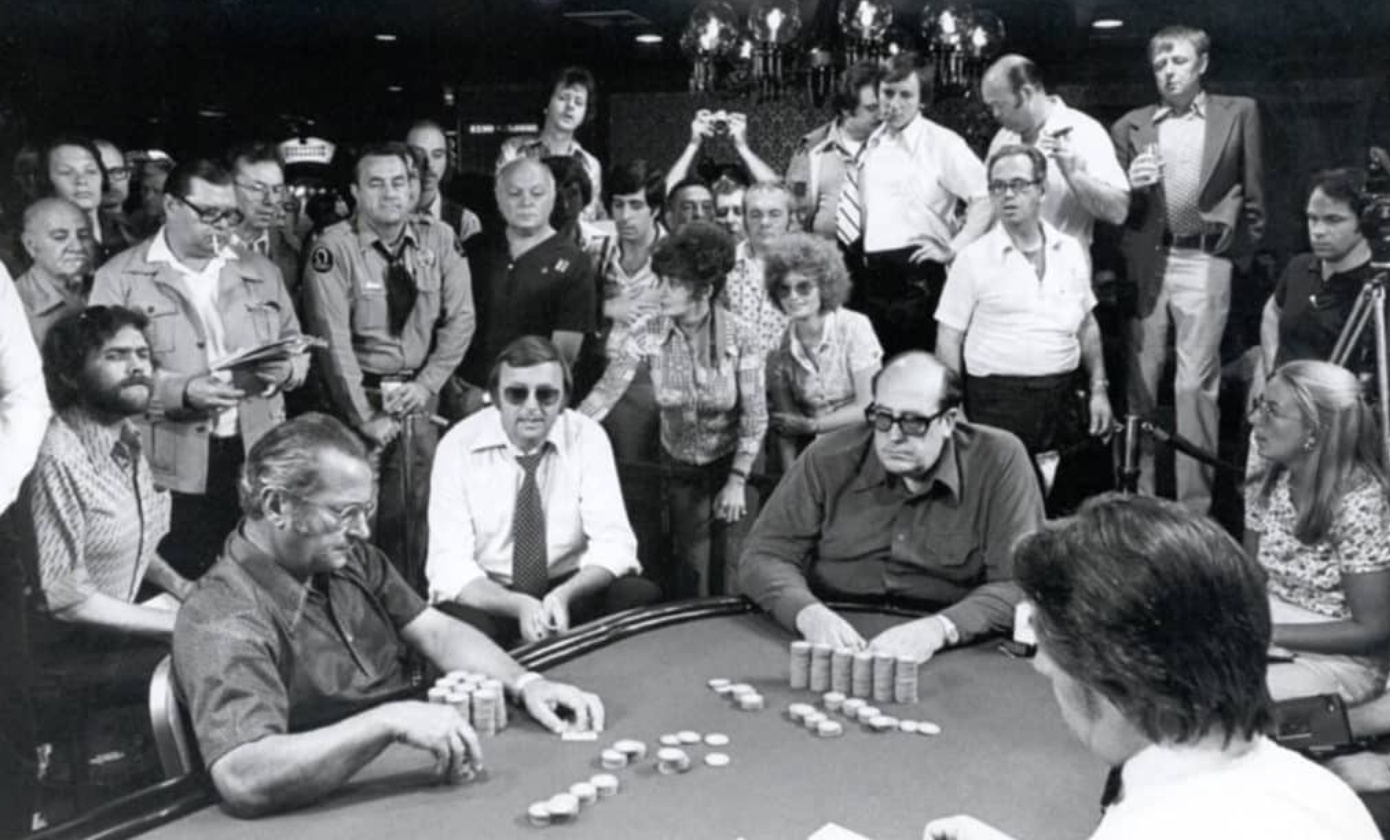
Brunson attacked after Alto lost several pots in a row. Doyle held an unimpressive 10 s 2 s, while Jesse Alto had a strong A s J h. The flop A h J s T h gave Alto two top pairs, but his pot-sized bet didn't deter Brunson, who called.
The turn 2 c gave Brunson a second pair, and he went all-in, with Alto correctly calling. At this point, Alto was a 90% favorite to win and double his stack. Then, a miracle happened. The river brought a T d, completing Brunson's full house.
Doyle Brunson won his first Main Event, claiming a $220,000 prize. The decisive hand became immortal and still carries the name of this legendary player. Jesse Alto, who reached seven Main Event final tables in his career, never won a bracelet.
The Legacy of 1976
This year wasn't just about money; it solidified poker as a serious competition. Doyle Brunson later admitted that while players previously measured success only by money, WSOP changed that, making tournament titles a significant part of one's reputation.
Brunson's triumph with the hand 10-2 was just the beginning. A year later, the world would watch in awe as history remarkably repeated itself. These unforgettable stories popularized poker and the WSOP more than the massive tournament winnings.
More From WSOP History
The History of WSOP: 1974 – Johnny Moss's Return to the Throne and the Birth of Iconic Bracelets
The History of WSOP: 1973 – Puggy Pearson's Triumph and the Dawn of the Television Era
The History of WSOP: 1972 – Amarillo Slim's Controversial Win
The History of WSOP: 1971 – The First Freezeout Tournaments
The History of WSOP: 1970 - The First World Champion Elected by Vote
Sources: WSOP, Wikipedia, PokerListings, PokerNews, GGpoker

