

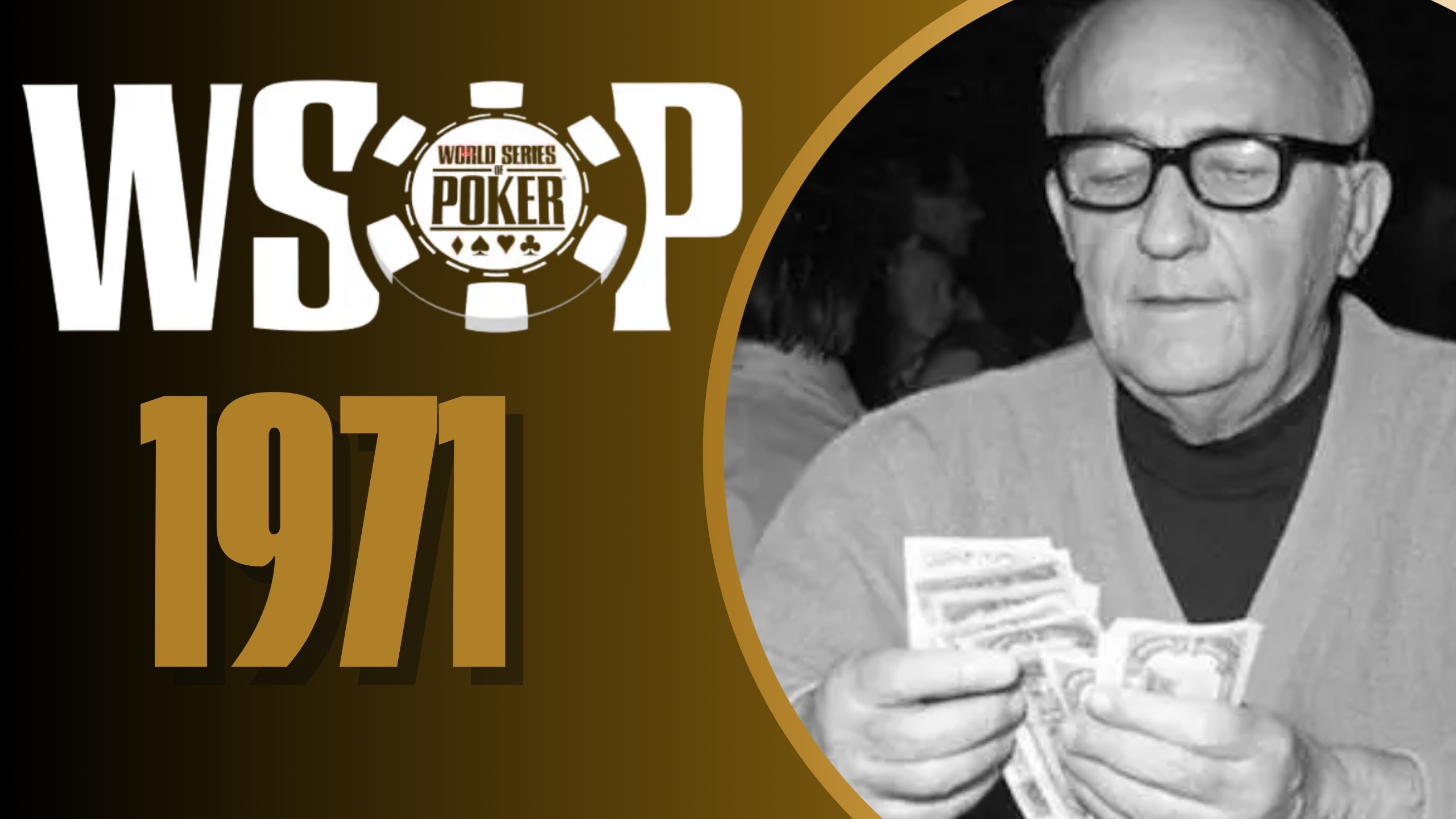
From Voting to Tournaments – Binion's Evolution
After the quiet debut of the WSOP in 1970, where the champion was chosen by simple vote, Benny Binion knew poker needed drama. Cash games were great for gamblers, but not thrilling enough for Vegas. Binion realized poker had to become a show. This was echoed by an article in the Los Angeles Times post the inaugural year, where reporter Ted Thackrey Jr. labeled cash games as dull. But if they could be made into a competition, it would earn publicity.
Benny Binion introduced the first freezeout tournaments — a format where players are gradually eliminated until one winner remains. According to one story, poker pro Amarillo “Slim” Preston brought the idea to Binion; another credits Puggy Pearson. Regardless of whose brainchild it was, history proved it a genius move.

Minimal Participation
In early May 1971, Binion's Horseshoe hosted five events. The first four had a $1,000 buy-in, with the Main Event at $5,000. The number of players was small and incomparable to today. Only 6 players entered the Main Event, with 10 reported for each side event. Yet, the quality outweighed quantity. The action featured top poker pros like Johnny Moss, Doyle Brunson, Puggy Pearson, Jack Straus, and Bill Boyd.
Ironically, participation was lower than the first WSOP year. This was due to high-stakes cash games in Vegas at the time. Thousands of dollars exchanged hands. Amateurs from across the U.S. came to try their luck in the desert city. For the true road gamblers of that era, such cash games were heaven. Amarillo Slim, reputed creator of the tournament format, didn’t even enter the Main Event, choosing instead to best tourists.
In 1971, no one knew the WSOP bracelet would one day mean millions and eternal fame.

The Series and Moss’s Historical Mark
On May 6, the series opened with the $1,000 Limit Seven-card Stud event. Puggy Pearson, known for his audacious bluffs and psychological play, became the first-ever tournament winner. This win was just the start for Pearson at the WSOP, with his most famous moments arriving two years later.
The second day was claimed by Jimmy Casella, who dominated the $1,000 Limit Razz. The third day saw Bill Boyd's emerging dominance in 5 Card Stud. Boyd continued his winning streak in this game for the next three years. The WSOP eventually dropped this event, and it’s jokingly said Boyd was to blame — he was so good that others tired of playing, especially losing, to him.
On May 9, the $1,000 Limit Ace-to-Five Lowball saw Johnny Moss shine. For the 1970 WSOP champion, it was just an appetizer before the Main Event. There, six elite players faced off: Johnny Moss, Jack Straus, Doyle Brunson, Jimmy Casella, Puggy Pearson, and Sailor Roberts. Impressively, five of them would later boast Main Event titles.
The freezeout format meant the winner takes all, and Johnny Moss proved the previous year's vote had indeed chosen the best. Moss became the first player to win two consecutive Main Events and two consecutive tournaments in a single year.

|
Tournament |
Entries |
Winner |
Prize |
|
Event #1: $1 000 Limit Seven-card Stud |
10 |
Puggy Pearson |
$10,000 |
|
Event #2: $1 000 Limit Razz |
10 |
Jimmy Casella |
$10,000 |
|
Event #3: $1 000 No Limit Five-card Stud |
10 |
Bill Boyd |
$10,000 |
|
Event #4: $1 000 Limit Ace-to-Five Lowball |
10 |
Johnny Moss |
$10,000 |
|
Event #5: $5 000 No Limit Hold'em Main Event |
6 |
Johnny Moss |
$30,000 |
The Experiment Succeeded
WSOP 1971 wasn’t about big numbers; it was an experiment that worked. Benny Binion aimed to create a spectacle, and he succeeded. With only six players at the Main Event table and just five small tournaments overall, 1971 changed everything. Without these small steps, the modern WSOP wouldn’t exist. The freezeout format worked. Elimination brought drama. Poker was never just about endless cash games in the backroom again.
More from WSOP History
The History of WSOP: 1970 - The First World Champion Elected by Vote
Sources: WSOP, Wikipedia, PokerListings, The Hendon Mob, Les Chroniques de Vegas

