

Three Card Poker is not that kind of environment. You are not facing opponents making emotional mistakes. You are facing fixed rules and predefined payout structures approved by gaming regulators. That changes everything. So is it beatable? Not in the traditional poker sense. But the reasons why are worth unpacking and a deeper look.
How the Game Is Structurally Built
According to the California Bureau of Gambling Control’s published Three Card Poker rules, the game operates as follows:
- Player places an Ante bet
- Player and dealer each receive three cards
- Player may fold or place a Play bet equal to the Ante
- Dealer must qualify with Queen high or better
- If dealer qualifies and player wins, both Ante and Play pay 1:1
- If dealer does not qualify, Ante wins and Play pushes
Source: California Department of Justice, Bureau of Gambling Control. Three Card Poker Rules (official PDF)
That document is not marketing material. It is regulatory documentation. The payout structure is not flexible. It is approved and fixed. That fixed payout structure is where the house edge lives.
Hand Distribution: Why Strength Is Compressed
Three Card Poker uses a standard 52-card deck, but because only three cards are dealt, hand probabilities differ significantly from five-card poker. The ranking order is officially defined in regulated casino rule sheets as follows:
- Straight Flush
- Three of a Kind
- Straight
- Flush
- Pair
- High Card
Notice that Straight outranks Flush. That reversal exists because Flushes occur more frequently than straights in a three-card distribution. Using combinatorial math from regulated casino analysis, the approximate probabilities are:
Three Card Poker Hand Frequencies
|
Hand |
Approx. Probability |
|
Straight Flush |
0.22% |
|
Three of a Kind |
0.24% |
|
Straight |
3.26% |
|
Flush |
4.96% |
|
Pair |
16.94% |
|
High Card |
74%+ |
The key takeaway is that high card hands dominate the distribution. That heavily influences optimal strategy.
The House Edge: What the Numbers Say
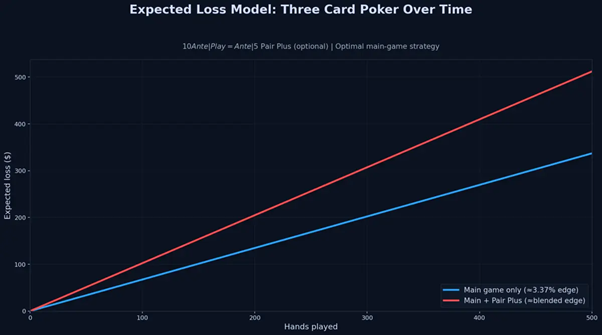
Under the standard Ante/Play pay structure approved in most U.S. casinos, the house edge is approximately 3.37 percent when optimal strategy is used. This number appears consistently across regulated casino mathematical disclosures and approved game submissions.
For context:
- Blackjack under favorable rules can be under 1 percent
- American roulette is 5.26 percent
- Many slot machines exceed 7 to 10 percent
Three Card Poker sits in the middle. The Pair Plus side bet typically carries a house edge around 7 percent or higher depending on the pay table, as documented in multiple regulated casino rule disclosures. So right away we see something important.
- The main game is negative expectation but moderate.
- The side bet is significantly worse.
If you are evaluating beatability, you cannot treat those equally.
The Only Optimal Decision: Q-6-4 Strategy
Optimal play in Three Card Poker is simple and widely documented in casino strategy guides:
- Play Q-6-4 or better.
- Fold anything weaker.
This threshold is derived from full combinatorial evaluation of all possible hands under the approved payout structure. It feels almost trivial compared to No-limit Hold’em decision trees. But the simplicity is deceptive.
- Playing looser than Q-6-4 increases the house edge.
- Playing tighter than Q-6-4 also increases the house edge.
There is exactly one narrow band that minimizes expected loss. In short, that is nothing more than loss control. If you’ve never actually applied this strategy threshold in real time, it’s surprisingly easy to misjudge borderline hands. Running through hands in a Three Card Poker simulator can help internalize the rule before sitting at a casino table, especially if you want to see how folding too loose increases long-term loss.
EV Modeling: What Happens Over 100 Hands?
Assume:
- $10 Ante per hand
- You always make the Play bet when required
- Average total wager per completed hand ≈ $20
- 100 hands played
- House edge 3.37% on total action
Total action over 100 hands:
100 hands × $20 average = $2,000 wagered
Expected loss:
$2,000 × 0.0337 ≈ $67.40
So under optimal strategy, over 100 hands at $10 Ante level, your expected loss is roughly $67. Now include regular Pair Plus betting at $5 per hand:
100 hands × $5 = $500 additional action
At 7% house edge = $35 expected loss
Now total expected loss becomes:
$67 + $35 = $102 over 100 hands
That is a 50% increase in expected loss just from the side bet. Over time, variance will mask this. You might win a session. But the math is stable across large samples. That is why Three Card Poker is not beatable long term.
Why Poker Players Struggle With This
Serious poker players are used to looking for an edge and leaks in other players. In Three Card Poker, there are no leaks to exploit. The dealer does not deviate from rules. There is no tilt, no adjustment, and no range imbalance. You are playing against a fixed probability model approved by gaming regulators.
What poker players do bring is discipline.
- They are less likely to overplay garbage hands
- They understand expected value
- They are less emotionally reactive to short-term swings
Those traits reduce damage, but they do not flip the sign of expectation.
Common Mistakes Poker Players Make at Three Card Poker
Three Card Poker’s simplicity creates a trap. Most losses are not from bad luck, but they they come from predictable misjudgments. Here are the ones we see most often.
Playing Every Ace-High
This is the biggest one, as poker players are conditioned to respect Ace-high hands. In Hold’em, Ace-high has real showdown value and blocking value. In Three Card Poker, Ace-King-3 is not automatically a continue. The correct threshold is Q-6-4. Deviating from that widens the house edge against you. The math does not care that you “feel ahead.”
Treating Pair Plus as Free Upside
The side bet looks attractive because it pays without dealer qualification. You hit a pair, you win. But with house edges often around 7 percent or more depending on the pay table, frequent side betting significantly increases long-term losses.
Ignoring the Pay Table
Different casinos offer slightly different Ante Bonus or Pair Plus payouts. Those small changes move the house edge. For example, some tables reduce straight payouts on Pair Plus from 6:1 to 5:1. That difference increases the casino advantage. Regulated casino rule sheets, such as those filed with state gambling authorities, make clear that payout structure is part of the approved game submission!
Overbetting Because It “Feels Simple”
Because the game has only one decision, players often increase their unit size. It feels less mentally demanding than poker. But the edge applies to total action. If you double your bet size, you double expected loss. Using earlier EV modeling:
- At $10 Ante, 100 hands ≈ $67 expected loss.
- At $25 Ante, same 100 hands ≈ $168 expected loss.
Practical Do’s
Stick to Q-6-4
This is non-negotiable if minimizing loss is your goal. There is no creative interpretation required.
Treat Side Bets as Entertainment
If you play them, understand the cost. Do not mentally categorize them as neutral add-ons.
Control Session Length
Because the edge compounds over action, longer sessions increase exposure. Short, defined sessions keep variance contained.
Understand Expected Loss Before You Sit
If you plan to play 200 hands at $15 Ante:
200 × $30 average action = $6,000 total action
$6,000 × 3.37% ≈ $202 expected loss
Knowing that ahead of time reframes the experience.
Is There Any Scenario Where It Becomes Beatable?
Under standard regulated casino conditions, no.. The rules are approved by gaming authorities and mathematically audited by these government authorities or third-party auditors like GLI. The payout tables are structured to maintain a long-term casino advantage.
Without rule changes, information asymmetry, or structural errors, the expectation remains negative. There is no card counting equivalent, no shuffle tracking, and no exploitable betting sequence. Three Card Poker is closed system math.
When Three Card Poker Still Makes Sense
Despite everything above, Three Card Poker continues to be widely offered in regulated casinos across the United States and Europe. That alone says something. The game is simple, quick, and it avoids the intimidation factor of full poker tables. Additionally, it offers controlled volatility.
If you treat it as entertainment with a known cost of roughly 3 to 4 percent of action, it becomes predictable rather than deceptive. For a poker player who wants a short session without deep mental engagement, after one of their (live) poker sessions, that predictability may even be attractive…

