

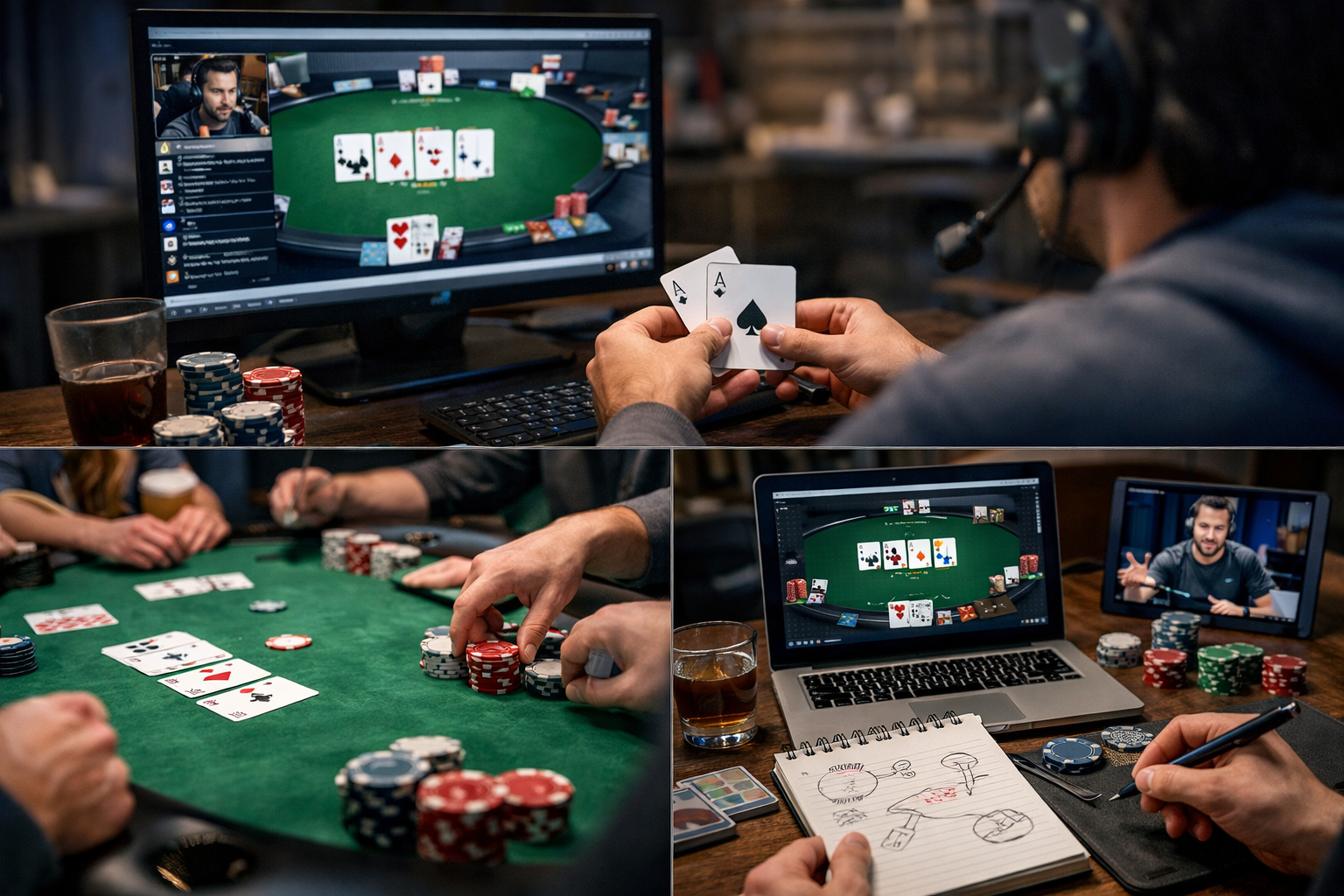
You watch for a few hours, then you sit down to play and your brain starts tagging spots in real time. “This is the squeeze spot.” “This is the thin value bet.” It’s like a sports replay where the commentator keeps circling the same gap in the defence, and now you can’t unsee it. Streams turn poker into something closer to learning a song by ear: you copy, you miss a note, you copy again, and the rhythm settles in.
The stream-to-table feedback loop
The fastest bridge from watching to doing is playing free poker, because it lets you run the idea in live traffic and feel how it lands. Replay Poker is where to start, a free game that drops you into real tables with zero cash risk, so you can test the exact spot you just watched and see how humans actually respond in the moment. The site spells out that it runs on play money, with optional purchases, and that it offers practice rather than cash prizes, which makes it a clean sandbox for experiments.
That “watch, then try” rhythm lines up with what researchers have found in live-stream learning more broadly. A widely-cited study in Computers in Human Behavior tested learning from Twitch-style instruction and showed that live-stream features like interaction and worked examples can support learning outcomes, especially when the material gets complex and the learner benefits from structure. Poker streams run on worked examples all day long: a hand history, a plan, a result, then a post-mortem.
The chat box matters too, even when you think you’re ignoring it. Live streams create teacher-learner and learner-learner loops, and that social layer is one reason people show up and stick around, according to review work on streaming behaviour. In poker terms, chat turns into a low-stakes study group where someone asks the “stupid” question you also had, so you get the answer for free.
You start practising decisions
Streams push you toward process goals because you see the same decision points at real scale, every day. In the past 30 days, Twitch viewers watched about 2.4 million hours of poker streams, with roughly 3,300 average viewers and about 66 average channels live. That volume means you keep seeing identical forks in the road, like “bet small or check,” so you start practising the choice itself instead of chasing results.
Repetition shows up in the data too. Those same Poker streams logged about 47.8 thousand hours streamed in the past 30 days, and the category ran around 49 viewers per live channel on average, so chat and commentary stay active enough to force explanations in plain language. When you replay a spot right after watching it, you move from “I saw that” to “I can name it,” and that shift matches controlled learning research on Twitch-style worked examples.
Streams also train coping routines in a measurable social environment, because people show up in huge numbers to watch and talk through mistakes in real time. Twitch as a whole logged 20.9 billion hours watched in 2024, so the platform has enough traffic to reward formats that keep attention through resets, quick reviews, and “here’s what I thought they had” breakdowns. You absorb that rhythm and you carry it into practice, where you treat each hand like a small decision you can rerun, rather than a judgment on your skill.
What “domination” looks like when you slow it down
Big wins get clipped, and streams make them feel close enough to copy. Andrei Kalgin dominated the recent WPT Prime Cambodia, taking home $154,170, yet the interesting part for practice lives in the boring details: pressure on short stacks, discipline with marginal holdings, and an ability to keep putting opponents in awkward spots.
When you watch final-table coverage or breakdowns inspired by runs like that, steal the habits rather than the hero lines. Streams reward the hand that looks clever, yet tournaments often get won by consistent, repeatable choices, as Alex Foxen exemplifies. Your practice target becomes “make fewer loose calls when tired,” or “choose one bluff spot per orbit and build it properly,” because those are skills that survive contact with real opponents.
Use play money as your lab, then bring the habit back to your usual games. That’s the quiet gift of streams: they give you a menu of ideas, and free online poker gives you a place to test them immediately.
Here’s a tight way to turn a stream into a practice session that actually sticks:
- Pick one concept the streamer used, then write it as a simple rule you can spot fast.
- Play a short session and tag only hands where that concept appeared, even if you misplayed them.
- Take one tagged hand and retell it in plain language, focusing on what you believed your opponent had.
- Rewatch the matching spot on the stream, then replay it once more in play money to lock the feel in.
That cycle keeps you grounded. You stay entertained, you keep the humour, and you still build real skill, one repeatable decision at a time.

