


To increase your chances of winning, it is worth learning and applying effective poker strategies, whether you are playing live or after completing your Revery Play login online. Whether you are a beginner or an experienced player, knowing basic and advanced techniques will allow you to make better decisions at the table. Success in poker depends not only on luck, but also on the ability to analyse situations, adapt to your opponents' playing styles, and consistently apply optimal strategies.
The basics of poker strategy
Effective poker play requires not only knowledge of the rules, but also the ability to make the right decisions based on an analysis of the situation at the table. Key aspects of poker strategy include:
- Starting hand selection – avoiding playing with low-potential cards. The better your starting hand, the greater your chances of success.
- Position at the table – the later your position, the more information you have about your opponents, which allows for a better strategy.
- Reading your opponents – analysing your rivals' playing style allows you to adjust your strategy and predict their moves.
- Pot management and stack protection – skilful control of bet sizes allows you to minimise losses and maximise profits.
- Bankroll management – proper management of your playing capital allows you to avoid losing your funds quickly.
- Discipline and patience – not every hand should be played. By waiting for a strong hand, you can avoid mistakes and losing chips.
- Adaptability – online poker is a dynamic game in which you need to adapt to the changing situation at the table.
This can make poker more profitable and improve your results in the long run.
1. Choosing the right starting hands
One of the foundations of effective poker play is the selection of starting hands. Not every pair of cards is suitable for play, so it is worth knowing which combinations have the greatest potential. For example, high pairs (AA, KK, QQ) or suited high cards close to each other (e.g. AKs, QJs) offer stronger winning prospects. Avoid playing weak hands that provide limited opportunities on later streets – the flop, turn and river.
2. Position at the table
Your position at the poker table, meaning where you sit in relation to the dealer, is crucial to your overall strategy. Players in late position, such as the dealer, have a clear advantage because they can observe their opponents’ decisions before acting. This allows for better adaptation to the situation at the table. In early position, it is generally advisable to play tighter and wait for strong hands.
3. Aggressive play and raising
Aggressive play involves frequent betting and raising, which can allow you to win pots without reaching a showdown. However, aggression should be controlled and based on solid reasoning, such as holding a strong hand or acting from a favourable position. Excessive aggression can lead to significant losses, so it is important to observe your opponents and adjust your approach to their playing style.
4. Bluffing and semi-bluffing
Bluffing is the art of representing a stronger hand than you actually hold in order to force opponents to fold. Effective bluffing requires an understanding of probability and your opponents’ hand ranges. Semi-bluffs, such as betting with a flush or straight draw, are particularly effective because they retain equity if called. A player who bluffs well can gain a clear edge over recreational opponents.
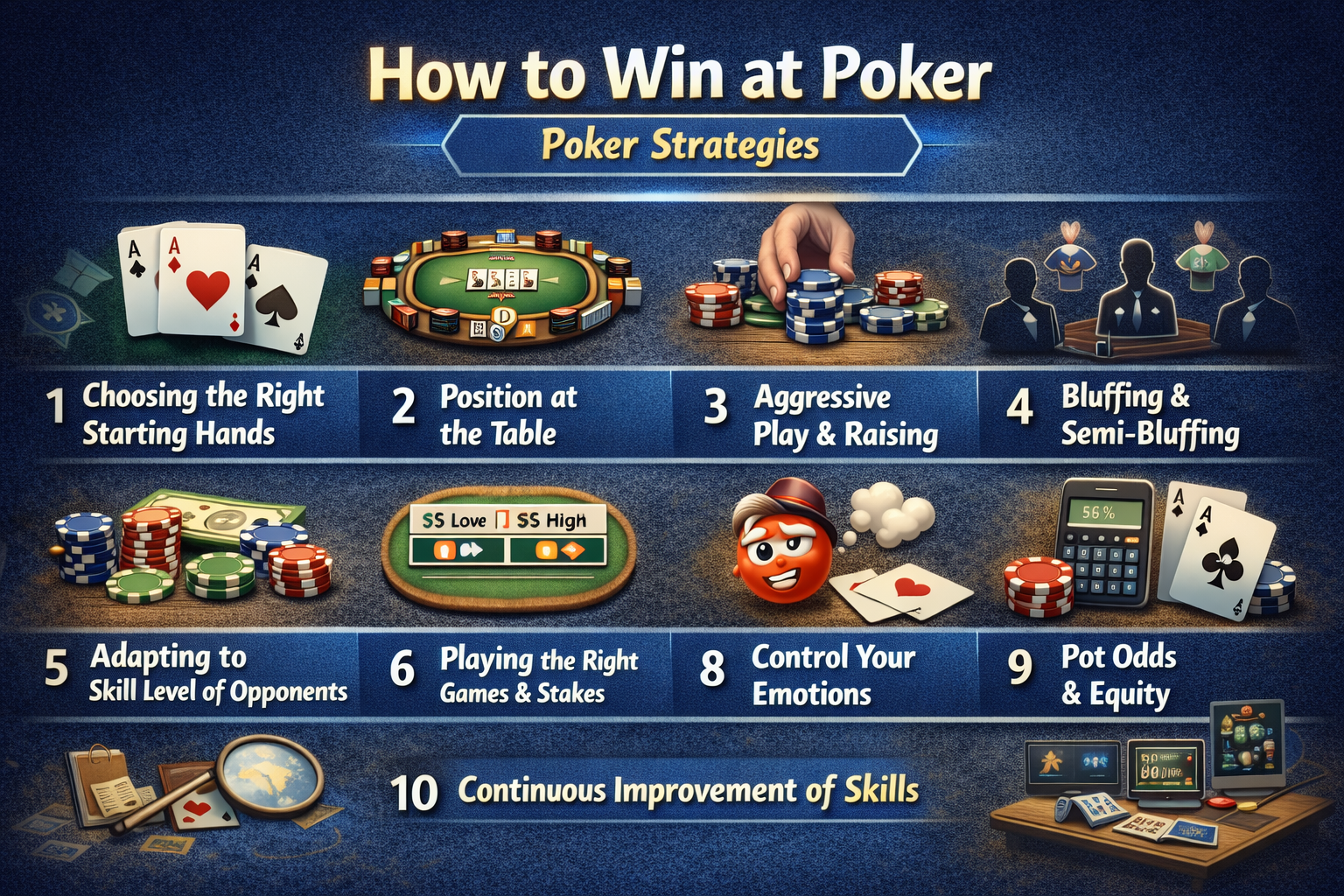
5. Adapting to the skill level of your opponents
Each player has a unique playing style, making adaptability a key poker skill. If an opponent limps frequently, you can exploit this passivity by raising more often. In MTTs (multi-table tournaments), it is especially important to adjust your level of aggression depending on the stage of the tournament.
6. Bankroll management
Proper management of your playing capital, known as bankroll management, is essential for long-term success in poker. Avoid committing too much of your bankroll in individual hands and choose stakes that suit your financial limits to reduce the risk of going broke. Many professional players recommend maintaining a bankroll at least 20–30 times larger than the standard buy-in for tournaments or the big blind in cash games.
7. Playing the right games and at the right stakes
Choosing the right table and the appropriate level of opponents is crucial for success in poker. Playing against significantly stronger opponents can lead to rapid losses, so it is important to select games that match your skill level. Beginners should avoid tables filled with professionals and focus on developing their skills at lower stakes. When playing online, analysing opponents’ statistics can also help you avoid particularly tough competition.
8. Control your emotions
Poker is a game in which emotions can strongly influence decision-making. It is important to avoid impulsive actions driven by frustration, excitement, or stress. The phenomenon known as “tilt” is one of the most common causes of losses, so learning to recognise emotional triggers and respond appropriately is essential. Taking regular breaks and using simple relaxation techniques can help maintain focus and strategic discipline.
9. Pot odds and equity
Better pot odds allow you to make more effective decisions about calling bets. It is worth analysing the cost of entering the hand and the probability of hitting a strong hand. Poker players who can calculate the equity of their hands have an advantage over other players at the table.
10. Continuous improvement of skills
Poker is a game that is constantly evolving, and the best players are constantly learning new strategies. It is worth analysing your own hands, watching poker tournament broadcasts and using statistical analysis tools. Learning from more experienced players and reading poker literature can also help improve your results. It is also crucial to test different approaches and tactics to find the optimal playing style suited to your skills and preferences.
- Playing the right games and at the right stakes – choosing the right table and level of opponents is crucial to success.
- Controlling your emotions – managing your emotions helps you avoid mistakes caused by frustration and overconfidence.
- Adapting to your opponents – adjusting your strategy to the playing style of other players is essential for long-term success.
- Continuous improvement of skills – analysing hands, watching professional players and using tools to track statistics allows you to develop your poker skills.
Conclusion
Poker, and its variants such as Texas Hold'em, is a game of skill, strategy and psychology. Using the right tactics and analysing your opponents' play allows you to achieve long-term success. Remember that even the best players do not always win – the key is to play consistently and learn from your mistakes. Regularly improving your skills, managing your bankroll and adapting to different situations at the table will make your game more effective.
FAQs
What is the strongest hand in poker?
In poker, the hierarchy of card combinations determines the strength of a hand. The strongest combination is a royal flush, which consists of an ace, king, queen, jack and ten of the same suit. Next in the hierarchy are a straight flush, four of a kind, a full house, a flush, a straight, three of a kind, two pair, one pair and a high card. Knowing these hands and their strength is crucial for effective play.
What is the most effective strategy?
There is no single universal poker strategy, as effectiveness depends on many factors, such as the playing style of your opponents, the type of poker, the betting structure and your level of experience. However, the most effective strategies include starting hand selection, positional play, aggressive play, bankroll management and the ability to adapt to your opponents. A good combination of these elements allows you to increase your advantage over your rivals and maximise your profits.
Is it possible to always win at poker?
No, even the best players do not win every hand. Poker is a game in which luck plays a certain role. However, the right strategy, the ability to read your opponents, and effective bankroll management can increase your chances of winning in the long run.

