

Photo by Michał Parzuchowski on Unsplash
Practicing without risking money is often framed as a beginner step. In reality, it is a training method that serious players keep returning to, because repetition is cheaper than tuition paid at the table. Risk-free practice works best when it is treated as structured work, not casual entertainment. The goal is to build decision habits that hold up when outcomes start to matter.
Practice starts with a narrow target
Poker strategy is broad: preflop ranges, postflop textures, bet sizing, bluff selection, and the mental game. Trying to "practice poker" as a single task usually turns into unfocused volume.
A more reliable approach is to set one target per session, then measure it. A player might spend twenty minutes working on opening discipline from an early position, or on defending the big blind versus small raises. "Decisions are the unit of practice" is a useful framing. Results vary. Decision quality can be repeated.
Play-money tables teach some skills, and distort others
Play-money games exist on many major poker platforms and apps. They offer volume, variety, and freedom to experiment, but they also bring unusual incentives. Players chase, over-call, and take lines they would not take when money is involved. That distortion does not erase the value. Fundamental habits can still be trained: selecting starting hands, tracking position, estimating pot odds, and building a routine for value betting. Those skills translate even when opponents behave differently.
Players who use play-money well often narrow the format further. They might treat a single session as a bet-sizing drill, or track only one recurring spot, such as continuation betting on dry flops, and ignore everything else happening at the table. The main adjustment is internal. When the chips are not real, discipline has to be. A player can set rules and follow them strictly, folding hands that "feel" playable but fall outside the plan.
Low-risk reps can come from adjacent formats
Not every useful practice session looks like a full ring game. Some players use short, repeatable drills to warm up their decision-making before deeper study. That is where small cross-training habits show up.
Quick sessions on casino-style games, including free video poker options, can sharpen pattern recognition and basic EV thinking, even though the game itself is different from Texas Hold'em. The value is limited and specific. It is less about learning poker lines and more about keeping the mind comfortable with odds, paytables, and fast, unemotional choices.
Hand review turns experience into usable data
The most common gap in risk-free training is that players log hands but do not extract lessons from them. A memorable hand becomes a story, not a study object. A practical review routine can be small. Three hands after a session are enough if the review is consistent. The key is to rewrite the hand as a set of questions: What range reaches the turn? What hands benefit from a bet? What does a raise represent in this spot?
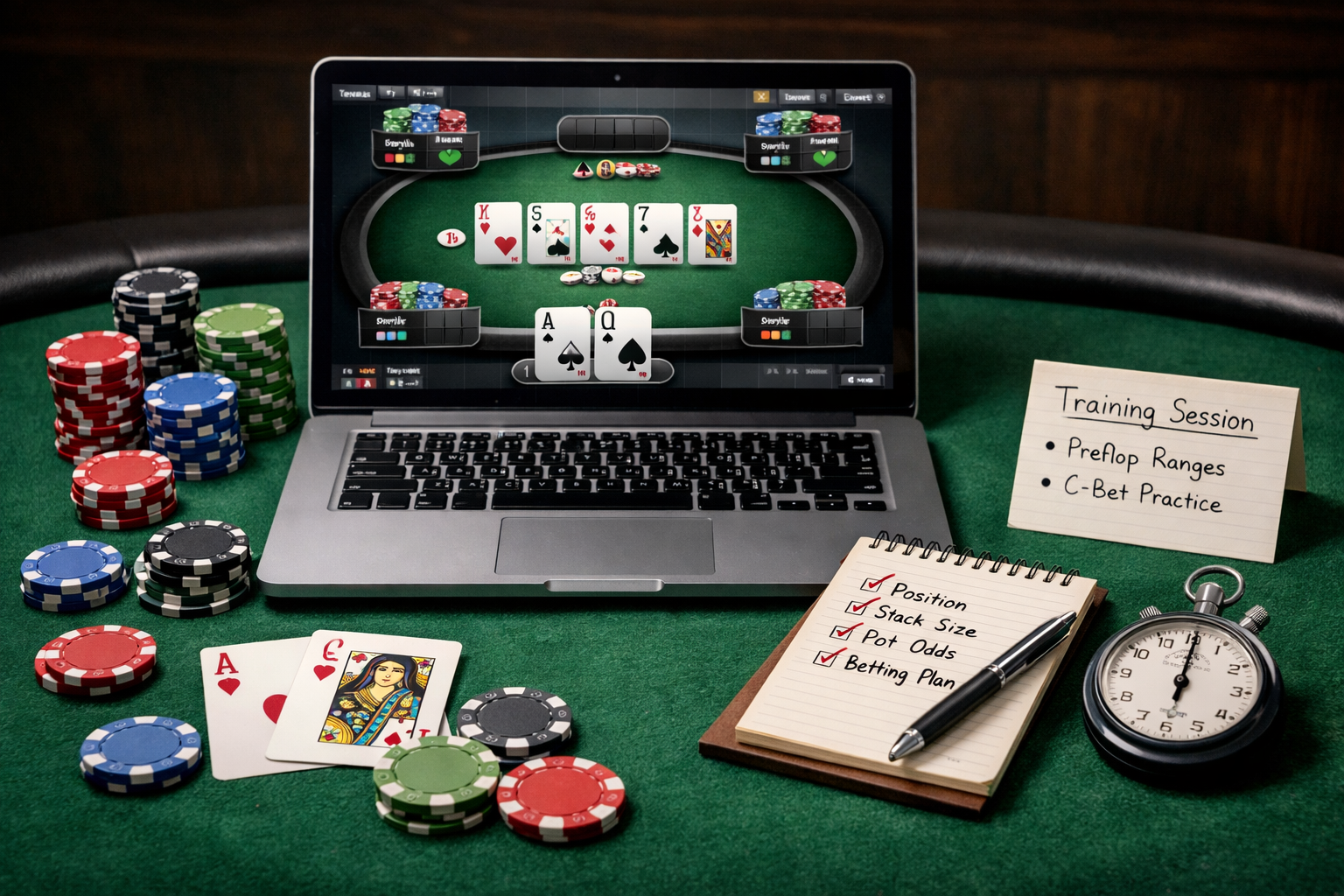
Even without automated hand histories, players can capture decision points. A screenshot and a short note about stack depth, position, and action can preserve what matters. The goal is repeatable thinking, not perfect record-keeping.
A checklist reduces autopilot
Many mistakes are not technical misunderstandings. They are lapses. A player knows the concept, then ignores it in the moment. A short checklist is a way to protect attention. Position, stack depth, range advantage, and board texture can be assessed quickly.
From there, the decision often narrows to three categories: value, bluff, or check and continue cautiously. In risk-free practice, there is space to slow down and run the checklist deliberately. Over time, the routine becomes faster. The point is not to become robotic, but to eliminate the costly gaps where "maybe" becomes an unnecessary call.
Pressure can be simulated, and it matters
The missing ingredient in free play is emotional consequence. Without it, players can drift into careless experimentation and learn bad habits. Some of that can be replaced with structure. Time limits, scoring systems, and simple accountability rules can create a mild pressure that keeps decisions intentional.
A player might use a shot clock or track deviations from a planned range as "mistakes" for the week. The benefit is not stress for its own sake. It is learning to stay stable through repetition, including through the boredom and frustration that often trigger poor play.
Practice poker strategies without risk summary
- Pick one skill per session, like preflop discipline, c-bets, or blind defense, and track it.
- Use play-money tables for volume and repetition, but expect looser, stranger opponent behavior.
- Create simple rules to stop drifting, like fixed opening ranges and a quick decision checklist.
- Mix in short drills that train odds and pattern recognition, but keep the goal narrow.
- Review a small number of hands every session, even three, and write down the decision point and your plan.
- Build light pressure without real stakes, using a timer, scorecard, or accountability target.
- Get feedback from a study partner or community so you can explain lines, not just replay outcomes.
- Treat risk-free practice as structured reps, so real-money sessions feel like execution, not improvisation.
Feedback loops separate practice from hope
Poker improves fastest when decisions are exposed to critique. That does not require a coach, although coaching can help. It can also come from a small study group, a friend who plays, or a community that reviews hands in detail.
The value of feedback is not agreement. It is the requirement to explain a line clearly. When a player cannot articulate why they bet, checked, or called, the decision is often based on a feeling rather than a plan. "If you can teach the spot, you understand the spot" is not a slogan; it is a test. Explaining forces with precision, and precision carries over well from free practice to real play.
Poker practice without financial risk is not about avoiding the game. It is about building a repeatable process before the stakes arrive. When the training has focus, structure, and feedback, the table stops being the classroom and becomes the exam. For many players, the surprise is that the "free" part is not the point. The point is the discipline to keep practicing when nothing forces you to.

