


Some players are also exploring different forms of gaming by checking a list of betting sites that offer entertainment related to poker. Meanwhile, technologies such as AI and cryptocurrencies continue to shape key gaming trends in the market. Keep reading this article to find out more about how digital gaming is transforming traditional poker.
Mobile-First Design
As more people continue to own smartphones, these devices have become the gateway to the online world of gaming. Mobile accounted for a big portion of the traffic on major online poker sites a few years ago, and this was expected to grow exponentially. By 2025, it had overtaken all platforms, with over 70% of players accessing poker on mobile devices.
Gaming providers have responded by creating mobile-first designs for better performance. This includes titles that support vertical and horizontal optimization as well as user-friendly touchscreen controls. Some platforms take it further by offering stable versions that can only be played on mobile devices.
AI Personalization
The global AI spending increased by over 50% from $987 billion in 2024 to $1.478 trillion by the end of 2025. And now, for 2026, it has risen to 2.02 trillion. This indicates how useful it has been in all sectors of the economy, including gaming. Poker game designers understand its effectiveness, and they have gradually integrated AI features in their algorithms. The aim is to improve user experience through personalization.
AI algorithms can monitor and record players' actions and offer recommendations based on personal preferences. Poker sites can now offer unique promotions, rewards, and marketing campaigns rather than relying on general marketing approaches. This helps reduce platform costs while creating an engaging experience for players.
Online-Live Crossovers
Gaming online was introduced to enable access to poker and other casino content from any location. This mode of gaming is available across various devices, but it uses a Random Number Generator (RNG) to determine the results. Recently, there has been a crossover from online versions to live versions that offer authentic experiences.
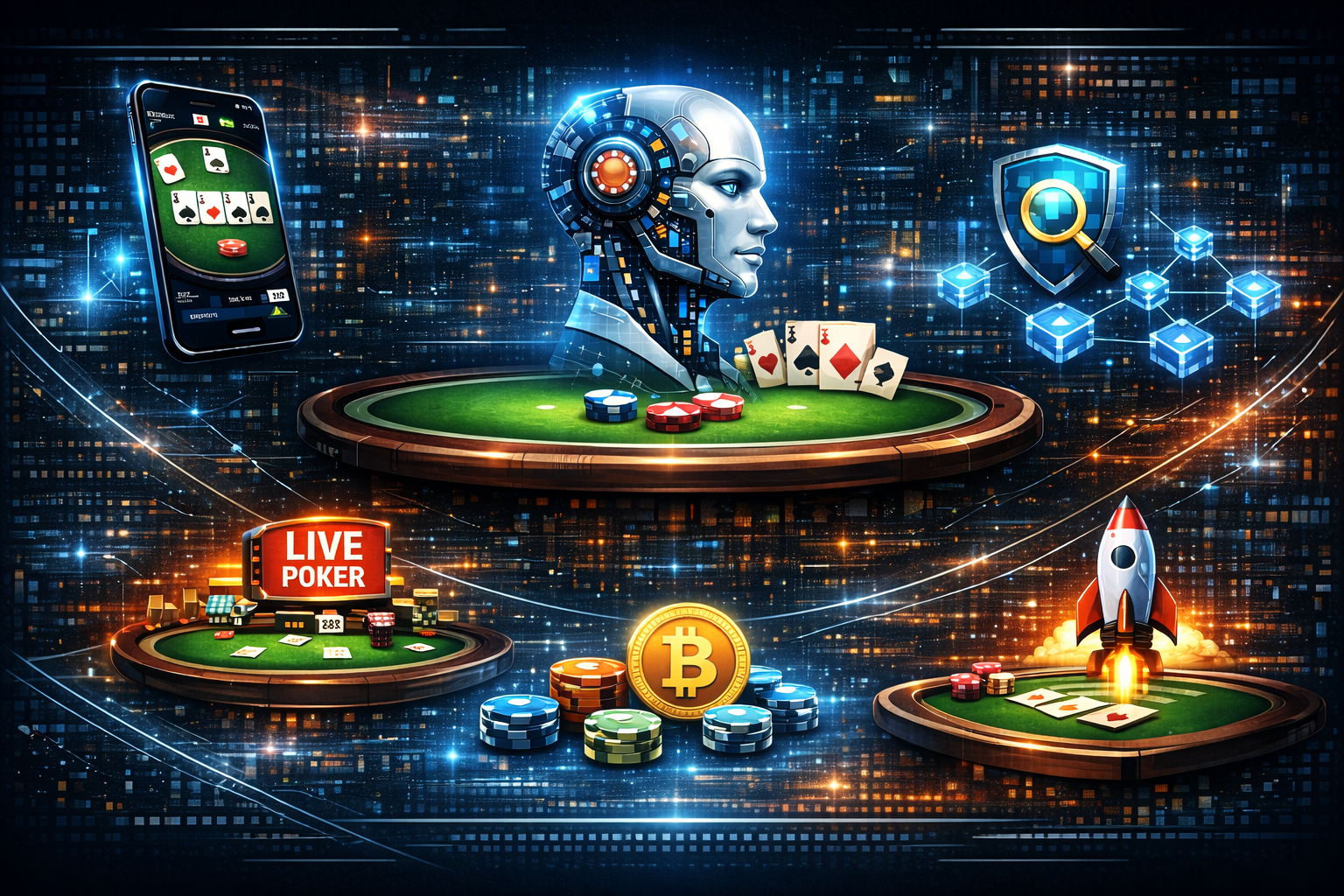
Live poker allows players to compete in real time via low-cost online satellites. In 2025 alone, more than 1,300 players qualified for the 2025 Irish Open, up from 700 in 2024. Moreover, live versions give low-stakes players the chance to compete in major live events, such as the WSOP Road to Vegas on GG and Power Path on PokerStars.
Fraud and Cheating Detection Systems
Although online poker is on the rise, cheating and fraud are still problems affecting iGaming. Newer technologies now provide different avenues for unethical behavior. Bots and other computer programs can act in place of human players, negatively affecting online and live poker.
In an effort to combat this, poker sites use a mix of human and AI detection systems that monitor for bots, collisions, and other forms of cheating. The algorithms will identify suspicious behavior or unusual activity, then hand it over to humans. If any form of cheating is detected, the accounts are usually banned.
Blockchain and Crypto Integration
Blockchain and crypto started as experimental features on most poker sites. Recently, it has become an industry standard for solving issues that poker platforms face in their operations. The first problem was banking restrictions. With cryptocurrency, players can make borderless payments on average within 10 to 60 minutes, compared to one to five business days with traditional banking.
Apart from payments, cryptographic algorithms are used with Random Number Generators (RNGs) to ensure the games are fair. Players can independently check and verify every shuffle because it cannot be tampered with. Moreover, it also enhances security because players don't have to share sensitive financial data when making payments.
What It Means for the Future
Poker has a clear direction for the future, which focuses on technology and innovation. This trend is expected to continue well beyond the next decade as platforms focus on mobile and crypto adoption. AI is also at the forefront of personalization through analysis to help players improve.

