


For cardrooms, it’s not just another regulatory tweak. It’s a direct hit to the very workaround that has allowed many venues to offer a casino-adjacent experience without technically becoming “house-banked.” For tribes, it’s the kind of win they’ve chased for years: a clearer line around exclusivity on blackjack and similar table-game territory.
The regulations take effect on April 1, 2026. But the fine print matters: cardrooms have 60 days after that to submit compliance plans to the DOJ, setting May 31, 2026 as the practical line in the sand. That gives operators a narrow window to re-tool their floors, re-train staff, and—most importantly—figure out which games still make economic sense once the “bank” can’t be reliably handled by paid props.
Prop Dealers: Still Allowed, But Now the Game Can’t Run on Autopilot
California cardrooms have deep roots—dating back to the Gold Rush era—but modern rules have always insisted on one crucial principle: no house-banked games. The workaround has been third-party proposition player services (prop players), paid to sit in and take the player-dealer role so everyone else can play as if a house is running the game.
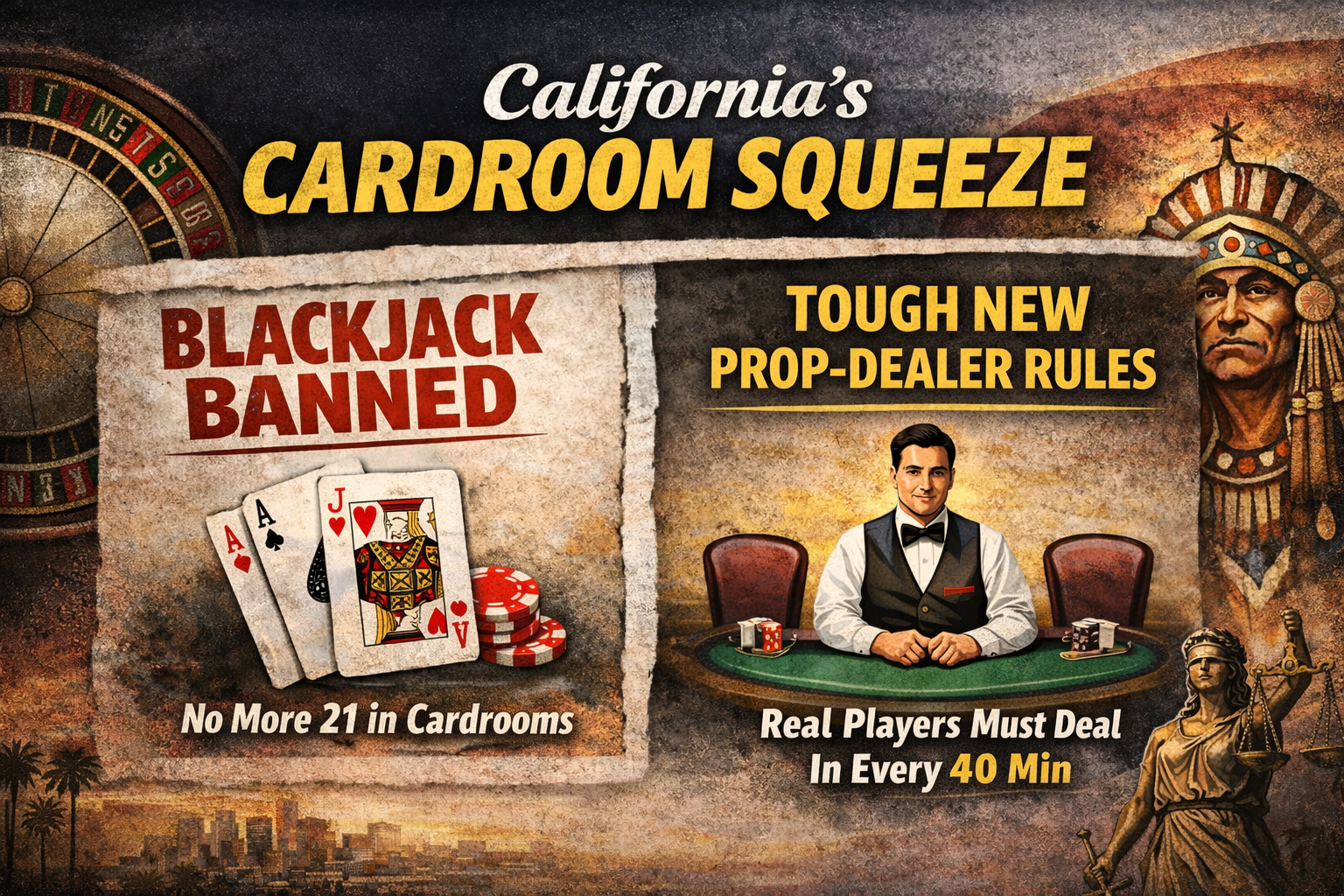
Under the newly approved rules, props don’t disappear—but they can’t carry the whole operation alone. The table must now see at least two “real” players (non-compensated, with no relationship to the cardroom) accept the dealer role for at least one hand each every 40 minutes. If that rotation doesn’t happen, the game must break until someone steps up.
In practical terms, that’s a major problem for the kinds of side-bet, jackpot-odds table games recreational gamblers love—because being the dealer in a hand with huge potential liability is not a seat most players will volunteer to take.While players might tolerate that risk in something like blackjack, it’s a very different story when long-odds side bets are on the felt.
The Real Hammer: Blackjack-Style Games Are Headed for the Exit
Even if cardrooms find clever social workarounds for the rotation rule, the blackjack ban is far harder to dodge. The regulations aren’t just banning the word “blackjack”—they’re targeting the mechanics that define it, clearly aiming to prevent a quick rebrand into “21-but-not-21.” That matters because blackjack-style tables have long been a major revenue driver in many cardrooms. Strip that away, and the ripple isn’t confined to pit games—it can reach staffing, operating hours, and potentially even the breadth of poker offerings if the overall business model tightens.
This ruling didn’t appear out of thin air—it’s the latest chapter in a conflict that’s bounced between courts, legislation, and regulators for years. Tribes have argued that cardroom table-game offerings infringe on exclusivity granted through compacts under the Indian Gaming Regulatory Act. There have been more failed court efforts, including a key federal court loss in 2019, and highlights how the 2024 Tribal Nations Access to Justice Act (SB 549) briefly opened a state-court lane for tribes to sue—only for that case to be dismissed when a judge ruled the dispute belonged in federal territory.
So when the courtroom path stalled again, the battlefield shifted back where California gambling wars often end up: rulemaking. Now, with OAL approval secured and compliance dates set, the question isn’t whether change is coming—it’s how cardrooms adapt, and whether the squeeze on casino-style offerings reshapes the live poker ecosystem in the state along with it.
Sources: oag.ca.gov, PokerScout

